Pages

Felicia Follum Art has moved

New Website and Blog

Hey all!!!! My Blog and Website have moved to feliciafollum.com  Be sure to head on over!!!  

Showing posts with label Make it Plain. Show all posts

Monday, February 3, 2014

The Locust Effect and The Problem of Poverty

The main topic in “The Locust Effect” breaks my heart. It is basically the argument that I made for my final project in my Ethical Philosophy of Global Justice class.

Violence and crime affect the poor. Trafficking, rape, and other forms of violence are problem of an unequal distribution of resources.

Though this book is specific to the developing world, it was seeing this poverty in my backyard as a kid that helped me to really see the problem of poverty for what it is.

Thursday, February 7, 2013

230 Nooses for Black History Month

I hope everyone has a fantastic Black History Month!!! I wanted to share some artwork with you from my last exhibition titled "Make it Plain."

This video shows a piece names 1982 and talks about why I chose to create 230 nooses. The song playing in the background, Strange Fruit by Billie Holiday, was also written out in one of my books. As you will see he goal of my noose artwork was to help people understand a bit more about African American history and the racism that existed and to some extent still does exist. You can see images of the finished piece at the end of the video.


To see more of my art check out my YouTube channel.

Friday, March 30, 2012

James Cone Graffiti Art

This graffiti style name drawing is in honor of James Hal Cone.
James Cone is an African American hero and the founder of Black Liberation Theology.
Make it Plain focused on religious leaders such as James Cone and Malcolm X. 

Cone is a fascinating theologian who combined the idea that you should love yourself first (Malcolm X) with the more well known ideals of Martin Luther King. 

Wednesday, March 28, 2012

Social Justice Today (and This Week)

Trayvon and his father
In the past two weeks I have had two sets of parents come talk to me about race and how it impacts their young children. One is the mother to an adopted son from Africa who had to watch her little preschooler come home and try to scrub his blackness off because he was told he was dirty and wasn’t allowed to play with the other kids at school. Anther, the father of a young girl, who had to deal with his daughter coming home crying and saying “I want blue eyes.” In addition was also a major event (The murder of Trayvon, a 17 year old boy) that made many people rethink the race situation in America.

The mom with the preschooler is now dreading telling her son that just because he looks a certain way, he will need to be careful in certain neighborhoods, he will not be able to wear certain colors or certain clothes. Even if he is on the honor roll and gets into a good school, people will assume it was affirmative action because he couldn’t possibly do it on his own.


Noose
The father with the girl gets to explain to his daughter that she is beautiful even though everyone she studies in school, everyone she is surrounded by, models she sees, and the majority of people in power do not have the same skin tone, eye color, or hair texture as she does. She will need to learn to love her own beauty in a world that does not call her beautiful but rather exotic or ethnic.

I am reminded of a story I was told about two police officers sitting in a bar across from one of my friends talking about profiling Native Americans just for fun.

I am reminded of the time(s) I have been profiled, followed through stores, or stereotyped simply because of the color of my skin. I am reminded of family members murdered because of their race (and their successes in a white neighborhood) and I am reminded of violence toward myself and my friends because of my dark skin.  I have been told what it is like to be black in America by many white folks and I am here to tell you what it is really like.

People ask why I chose to use nooses in my artwork.  This is why.  People need to see that, though better, things are still a mess. We are not beyond racism. Racism is learned and we have not adequately taught our preschoolers to accept others. We, ourselves, have not learned to fully accept others. We have not acknowledged these problems, nor have we decided to actively fight against them. 

The nooses not only force us to think about racism in its present day form, but allow us to remember those who have been murdered because of their race or other forms of prejudice and hate such as sexuality, or gender, even modern day slavery.  We are still fighting this battle...

Some helpful links

Black is Beautiful Pin Board - This is an excellent way to help focus on images of people that look like you.  Also turn off the television

Tips to help your child see themselves as beautiful even when people at school do not

My Black is Beautiful - Celebrating African American women

More of my Artwork

Body Image
Native American
Human Trafficking

Tuesday, March 27, 2012

Shabazz Ink Drawing


El-Hajj Malik El-Shabazz was Malcolm X's Muslim name. 

I have posted some about Malcolm on my SCKRLGN blog and other spots on this blog. You can also find information on Wikipedia (Most of it seems fairly accurate when compared to other sources, though it is still Wikipedia).

Friday, March 23, 2012

Make it Plain: Round Two

RSVP on Facebook
I am proud to announce that Make it Plain (click to read more) will be a part of the 16th Annual Shepard Symposium on Social Justice this year.

The opening for my solo exhibition will be held in the 234 Gallery (in the University of Wyoming Union) on Wednesday, March 28 from 6-8pm directly following a talk by Tim Wise (one of my favorite social justice speakers out there).

The show will be up from March 19 - 31.

If you missed my Make it Plain solo exhibition the first time around, be sure to check it out now.  I am proud to say that the first showing was quite a success and I believe this one will be as well.

It is in a larger and more prominent gallery space which only makes the work shine more.  The exhibition will be slightly different due to works that have been sold, recreated, or altered.

Sunday, March 11, 2012

Sharpton: Creating your own Graffiti Tutorial

Reverend Al Sharpton is a significant player in the field of African American religious culture.
Since I have a couple decent photos of this graffiti name drawing, I thought it would be appropriate to talk a bit about my process of creating my graffiti style letters.


 While I was creating these name drawings,
 I drew several versions for each name both in pencil and in ink. 


I always begin with doodleing some letters and seeing if I can get any to fit together.
Sometimes I will look up graffiti I like or have photographed to see if there are any inspirational graffiti styles or letters that I like.  If I find one, I create a font based on the characteristics of that letter.  The letters(s) I sue for inspiration allow me to create a unique style or font. 

I then continue to work on other letters of the name using a consistent style.
My typography class plays a huge role here. 
I learned about parts of letters such as the x-height, serifs, ascenders, descenders and several more aspects of developing fonts and typefaces.  I know to keep a consistent x-height and I usually drop rounded letters just below the baseline.

Once I decide on the rules I can create most any word I want out of that style.  I think I have created around 7 different graffiti letter styles.

After creating the outline I decide whether I want the text to be 3-D or flat.

The last step is to add a background and value.

See more of my graffiti photographs and inspiration.

Wednesday, February 22, 2012

Marcus Garvey

Marcus Garvey is a significant figure in the field of African American religious culture for a variety of reasons.  He played a major role in the Back to Africa movement as well as the RastafarI religion.  In addition he was viewed by many as an African prophet.


Read more about Marcus Garvey on my religion blog, Sick Religion.

Friday, February 17, 2012

Student Juried Exhibition

The annual Student Juried show is a pretty big deal at the University of Wyoming. This is my first time having work selected for the show.  Persistence certainly pays off.  My Malcolm X poster, titled "Who Taught you to Hate?" made it into this art show.

There are a variety of awards at the opening.  I received a purchase award from the Information Technology department and the Margaret Murdock Award for Social Justice cash award.

After the opening reception all students with work attend an after party with the president of the university, the college, and the Art Department faculty.  This event is referred to as the “Prom for the Art Department.”

Though this event is over there is certainly time to visit the University of Wyoming Art Museum.  There is even an audio recording about this work to which you can listen.

Check out my Facebook page for more artwork and photographs from the event.

Monday, February 13, 2012

The Good Mule: Artist Statement

This past weekend I was fortunate to be able to attend The Good Mule 2012 Conference as the Featured Visual Artist. I participated last year so was pretty excited about being invited to be the artist. See more of my thoughts from The Good Mule.

I am currently finishing up my last semester at the University of Wyoming and will be graduating in May. I will be graduating with a in Fine Arts and a second major in Humanities and Fine Arts (HUFA) as well as a minor in Graphic Design. My areas of emphasis for the HUFA degree are Philosophy, Religious Studies, African American and Diaspora Studies, and Art History. My dream job is to have an art studio where I can continue to create art and work with people through teaching, art therapy, and graphic design lessons.

The pieces that are on display come from a couple different bodies of work and addresses a variety of topics. These topics include LGBTQ issues, Christianity and the LGBTQ community, African American religious culture and history, Native American reservations, and poverty.

Make it Plain is my most recent body of work and focuses on African American Religious history and culture with the goal of helping people understand religious figures such as Malcolm X and James Cone. Make it Plain will be up in the 234 Gallery during the Shepard Symposium. If you would like to see the entire show, this would be an excellent opportunity.

My next body of work will be dealing with sex trafficking and modern day slavery. Be sure to check out my blog and Facebook page to track the progress of my upcoming work and learn more about individual pieces and the research that went into their creation. The URLs are on my business card.

I am certainly up for discussion about concepts, inspirations, the bodies of work these individual pieces come from, collaborations, sales, or art and activism in general.

To learn more about the Good Mule check out their website.

Saturday, February 11, 2012

Why We Must Kill Those Bastards: An Essay by General Nathan Bedford Forrest

This book began with a lot of play (you might not have guessed that from the content).  I wanted to see how I could play with form and pages of a book created from one sheet of paper folded to create pages.  It ended as a very strong piece showing some of the hatred our country was built on.


This essay was written by General Nathan Bedford Forrest, Civil War hero and found of the KKK, about why the Klansmen needed to fight against Negros, Jews, carpetbaggers and a variety of other hated people groups.  This essay plays on the fear and ignorance that if they don't fight to the extent that we are willing to kill anyone who is not a white Christian with the same cultural background, they will loose everything. 

This essay was found in a book compiled of the essays of various Klan leaders.  Some gave the history but many really focused on the core values.  This book really helped me gain an understanding of the psychology behind racism.

Much like the modern day Klan the original Klan was formed on the foundational values of hatred, ignorance, and racism disguised as self-love.

Wednesday, February 1, 2012

Strage Fruit in Book Form

Southern trees bear strange fruit
Blood on the leaves
Blood at the root
Black bodies swinging in the southern breeze
Strange fruit hanging from the poplar trees
Pastoral scene of the gallant south
The bulging eyes and the twisted mouth
The scent of magnolia sweet and fresh
Then the sudden smell of burning flesh
Here is a fruit for the crows to pluck
for the rain to gather
for the wind to suck
for the sun to rot
for the tree to drop
Here is a strange and bitter crop

Composed by Abel Meeropol (aka Lewis Allan)
Originally sung by: Billie Holiday


Monday, January 16, 2012

Who Taught You to Hate Yourself?

Although King and Malcolm had their differences (theological and social) I would like to share a poster I created featuring the famous Malcolm quote "who taught you to hate yourself" in honor of Martin Luther King day.  Malcolm and King were both extremely important leaders in the African American community and the Civil Rights movement and both deserve to be honored.  The goal of my art exhibition was to create dialog about race, religion and the significance of African American history.  King and Malcolm both succeed in pushing this same conversation forward.


Below is an example of how young children have been taught to hate themselves through the images they see and what they are told.


Another video on the topic (great for parrents)


Martin Luther King

In honor of Martin Luther King Day I figured I would share this drawing.

I completed a series of African American History name drawings.  
Some are of heroes or African American religious figures like this one
and other are of people who have become famous for a variety of reasons.


I also thought you might enjoy reading
MLK's Letter from Birmingham Jail

Saturday, January 14, 2012

American Dream: The Good, The Bad, and The Ugly Truth

American Dream

Though America is great, it is important to remember the true history of our country.  It was built on the backs of African slaves and is currently being built on the backs of underpaid, overworked Latinos and other under-privileged people groups (sometimes slaves). Avoiding reality will not make it go away (as we just saw in "History can't be Undone, But it can be Erased").  The idea of the American Dream is based upon ideas that many will never be able to achieve.

Inspiration for American Dream

This work began as a part of 1892 (post coming soon), a work depicting the large number of lynchings in 1892.  America began with the slave trade.  Laws were passed allowing the murder of blacks and lynchings were a weekly occurrence after church on Sundays.  American Dream depicts how American history and some aspects of culture are so ingrained in the culture and our understanding of what it means to be American (even if some refuse to admit and confront this history).  This work is meant to be a criticism (constructive criticism) of America today as well as a reminder of our history.

The American Flag

I understand that the American flag can be overused; however, it can also be a powerful symbol for cultural values. The flag is the perfect symbol to show our country's history.  I would like to continue to use the flag as a symbol in my next body of work which will be focusing on sex trafficking.  The flag has also been used in mys past bodies of work.  See my Native American history poster "Incarceration.

Exhibition Feedback

I was talking to a man at the opening; he was reading a slave narrative and this piece really resonated with him.  The book he was reading talked about how breeding with female slaves was just an everyday topic and part of American culture.  One of my favorite aspects of having this exhibition is how many conversations were started in response to the serious topic.  Art is a powerful too for social dialog an change.

On a side, but related not, attacks on the LGBTQ community are becoming increasingly common by the same groups (such as the KKK, neo-Nazis, radical Nationalists, and racialists).


Thursday, January 12, 2012

Klanstory


Klanstory gives a brief backgroung of the various Klans from a variety of time periods including the present and largest Klan.

This book describes the origins of the Klan and the reasons for their costumes. 


 The video Birth of a Nation played a vital role in the resurgence of the Klan.


This Christian group saw the burning cross as a sign of Christian brotherhood.


Saturday, December 31, 2011

2011 Highlight for Felicia Follum Art + Design

I found the idea of sharing the highlight of my artwork of 2011 with you while reading the Art Biz Blog and decided that it would be beneficial to post about my most significant accomplishment of 2011.

The accomplishments that I am the most proud of revolve around my most recent art exhibition and body of work, Make it Plain.  Make it Plain was my first solo show, none of the work was created for school in any way and the amount of research that went behind the work was huge.

I am extremely excited about the work itself. I am proud of the quality and quantity of the art. I am proud to say I have a cohesive body of work.  In addition to the work itself, I am excited about the responses from both the community.

The African American and Diaspora Studies, Religious Studies and Philosophy departments all supported my work and I was even asked to submit my exhibition to another gallery on campus. The African American and Diaspora Studies department encouraged students to attend my show and writing their final papers on my body of work was an option. The 234 Gallery focuses on social and educational artwork.  I was contacted after the application deadline and encouraged to apply to display my work in their gallery.  I am proud that my art exhibition will be on display in the same gallery as a photographer for the National Geographic.

Thanks for all you support and time spent reading my blog and looking at my work. I couldn’t have achieved what I have without you.

Check back tomorrow to see my goals for 2012.

Sunday, December 25, 2011

James Cone's Black Jesus

This poster is designed to represent James Cone's theology as a part of my Make it Plain art exhibition.  James Cone was a theologian who made the idea of a black Jesus famous.  James Cone believed in a Jesus that was with the oppressed people of the day; in the 1960's the oppressed peoples were black. 

Cone was responding to all of Christians who believed in a white Jesus and a white God that supported to oppression, murder, enslavement, and oppression of blacks.  James Cone responded with the idea that Jesus represents the oppressed peoples, and the Jesus Cone talked about was black.  When the racism supporting 230 lynchings in a year is still prevalent 70 years later there is a need for the Christian faith to evolve for the better.  James Cone did that in part by building on Martin Luther King's black theology.

Cone combined Malcolm's ideas of self love and Kings philosophy of loving others.  Cone  used MLK Jr's Black Christian theology (which still had some grit if you read his actual sermons).  James Cone is known as the founder of Black Liberation Theology .


People who have heard of James Cone in response to the anti Obama campaigns, have heard incredibly distorted views of what black Liberation Theology actually is.  These same people seem to forget the circumstances that men like James Cone and Malcolm X were responding to and living with on a daily basis. 

Through my conversations with anti-Cone and anti-Obama extremists, it seems that verry few of them have read Cone, King or Malcolm beyond what we get in high school and none of them have studied American history from any other perspectives than standard European-American history.  Not that this is bad, they just done seem to have a grasp on a variety of people groups experiences.


Monday, December 19, 2011

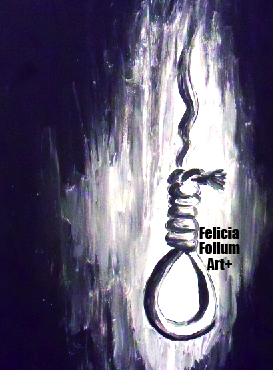
Noose

Photo featured in the Laramie Boomerang November 10, 2011
This Noose painting was an experiment 
created during the 1892 process
Noose was painted on top of wall art 
again showing the contrast between fake (though beautiful)
and honest.  Speaking to the covering up of the past.
This idea of covering up the past is not as clear as in History Can't be Undone...
I chose to include this work in 
Make it Plain beacuse it had a strong use of lights and darks.  


Monday, December 12, 2011

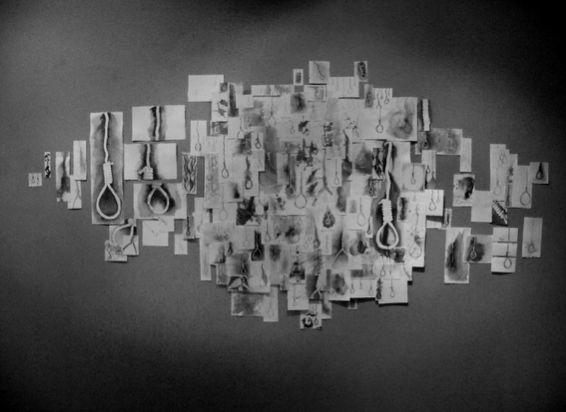
1892: 230 Lynchings in America

There were 230 people lynched in 1892 and this piece is dedicated to each of those individuals.


Lynchings in One Year

1892 (originally titled 230 nooses) is the piece that started the idea of using nooses. Through research I found that there were 230 people lynched in 1892.

Viewing X and Cone in Historical Context

I had been trying to figure out how to help people understand Malcolm X and James Cone, two historical figures often misunderstood. Using nooses to show the extent of the overwhelming hatred, racism, ignorance, and bigotry to which they were responding seemed like a perfect solution to help people see the necessity for their intensity. I wasn’t sure where I was going with this idea of creating nooses or how I was going to display the 230 drawings. All I knew was that I had to make over 20 every week to make enough in time for opening night.

Experimenting

In addition to the 230 nooses, this piece actually morphed into several other works including Negro Family Tree, History Can’t be Undone, but It Can be Erased, American Dream, and Noose. The variety of works developed through the process of making 230 drawings.  I experimented and the experiments ended up being separate works.  The text hidden in this piece is composed of quotes from KKK leaders and essays I read while researching for Make it Plain.  These quotes and more text will reappear in a post about one of my books exhibited in this art show.


www.FeliciaFollum.com

My blog and website have moved. Be sure to check out www.Feliciafollum.com