Pages

Felicia Follum Art has moved

New Website and Blog

Hey all!!!! My Blog and Website have moved to feliciafollum.com  Be sure to head on over!!!  

Showing posts with label Native Americans. Show all posts

Monday, February 3, 2014

The Locust Effect and The Problem of Poverty

The main topic in “The Locust Effect” breaks my heart. It is basically the argument that I made for my final project in my Ethical Philosophy of Global Justice class.

Violence and crime affect the poor. Trafficking, rape, and other forms of violence are problem of an unequal distribution of resources.

Though this book is specific to the developing world, it was seeing this poverty in my backyard as a kid that helped me to really see the problem of poverty for what it is.

Thursday, October 17, 2013

Graphic Design Questions

Book cover for Captured Justice.
 See more Native American social justice posters 
Before I begin a graphics project I tend to ask several questions to help me get a better understanding of what the client desires.

Here are the questions I ask.

1. What is your business? Name? What do you do? Ideas? Images?
2. If you had to describe your desired/typical clients in a short paragraph what would you say about them? Age? Gender? Style? Culture? Class? Etc.
3. Is there anything else I need to know?

Other questions that may apply

What imagery are you leaning towards?
What are you trying to say with the imagery, that is not being said in the text or business name?
Do you want this type, image, or color heavy?

What questions do you ask your clients before beginning a project? Are they similar? Is there anything I forgot?

Tuesday, September 4, 2012

Captured Justice and Incarceration

I have been waiting to announce this achievement online for awhile now... 

My poster "Incarceration" was recently used as a textbook cover for a Native American History and Public Law textbook.  I was ecstatic when I received the hard copy in the mail. It looks great!!

The idea for this poster was largely inspired by growing up in Rapid City, South Dakota and seeing the mistreatment of, and racism toward, Native Americans.  The poster was created as part of a series addressing the conditions on American Indian Reservations (specifically
pine Ridge and Rosebud) after many hours of research.  The photo is an unknown chief from a portrait photography book.

Captured Justice: Native Nations and Public Law 280″ by Duane Champagne and Carole Goldberg
You can purchase the book online at Carolina Academic Press or on Amazon.com.

Wednesday, March 28, 2012

Social Justice Today (and This Week)

Trayvon and his father
In the past two weeks I have had two sets of parents come talk to me about race and how it impacts their young children. One is the mother to an adopted son from Africa who had to watch her little preschooler come home and try to scrub his blackness off because he was told he was dirty and wasn’t allowed to play with the other kids at school. Anther, the father of a young girl, who had to deal with his daughter coming home crying and saying “I want blue eyes.” In addition was also a major event (The murder of Trayvon, a 17 year old boy) that made many people rethink the race situation in America.

The mom with the preschooler is now dreading telling her son that just because he looks a certain way, he will need to be careful in certain neighborhoods, he will not be able to wear certain colors or certain clothes. Even if he is on the honor roll and gets into a good school, people will assume it was affirmative action because he couldn’t possibly do it on his own.


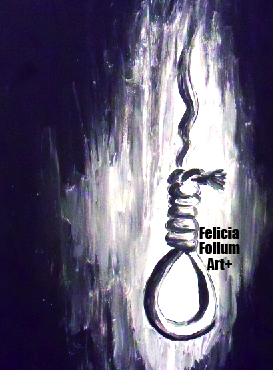
Noose
The father with the girl gets to explain to his daughter that she is beautiful even though everyone she studies in school, everyone she is surrounded by, models she sees, and the majority of people in power do not have the same skin tone, eye color, or hair texture as she does. She will need to learn to love her own beauty in a world that does not call her beautiful but rather exotic or ethnic.

I am reminded of a story I was told about two police officers sitting in a bar across from one of my friends talking about profiling Native Americans just for fun.

I am reminded of the time(s) I have been profiled, followed through stores, or stereotyped simply because of the color of my skin. I am reminded of family members murdered because of their race (and their successes in a white neighborhood) and I am reminded of violence toward myself and my friends because of my dark skin.  I have been told what it is like to be black in America by many white folks and I am here to tell you what it is really like.

People ask why I chose to use nooses in my artwork.  This is why.  People need to see that, though better, things are still a mess. We are not beyond racism. Racism is learned and we have not adequately taught our preschoolers to accept others. We, ourselves, have not learned to fully accept others. We have not acknowledged these problems, nor have we decided to actively fight against them. 

The nooses not only force us to think about racism in its present day form, but allow us to remember those who have been murdered because of their race or other forms of prejudice and hate such as sexuality, or gender, even modern day slavery.  We are still fighting this battle...

Some helpful links

Black is Beautiful Pin Board - This is an excellent way to help focus on images of people that look like you.  Also turn off the television

Tips to help your child see themselves as beautiful even when people at school do not

My Black is Beautiful - Celebrating African American women

More of my Artwork

Body Image
Native American
Human Trafficking

Monday, February 13, 2012

The Good Mule: Artist Statement

This past weekend I was fortunate to be able to attend The Good Mule 2012 Conference as the Featured Visual Artist. I participated last year so was pretty excited about being invited to be the artist. See more of my thoughts from The Good Mule.

I am currently finishing up my last semester at the University of Wyoming and will be graduating in May. I will be graduating with a in Fine Arts and a second major in Humanities and Fine Arts (HUFA) as well as a minor in Graphic Design. My areas of emphasis for the HUFA degree are Philosophy, Religious Studies, African American and Diaspora Studies, and Art History. My dream job is to have an art studio where I can continue to create art and work with people through teaching, art therapy, and graphic design lessons.

The pieces that are on display come from a couple different bodies of work and addresses a variety of topics. These topics include LGBTQ issues, Christianity and the LGBTQ community, African American religious culture and history, Native American reservations, and poverty.

Make it Plain is my most recent body of work and focuses on African American Religious history and culture with the goal of helping people understand religious figures such as Malcolm X and James Cone. Make it Plain will be up in the 234 Gallery during the Shepard Symposium. If you would like to see the entire show, this would be an excellent opportunity.

My next body of work will be dealing with sex trafficking and modern day slavery. Be sure to check out my blog and Facebook page to track the progress of my upcoming work and learn more about individual pieces and the research that went into their creation. The URLs are on my business card.

I am certainly up for discussion about concepts, inspirations, the bodies of work these individual pieces come from, collaborations, sales, or art and activism in general.

To learn more about the Good Mule check out their website.

Wednesday, August 10, 2011

Native American Posters

In response to all of the drama back home in Rapid City, South Dakota (link to the most recent drama), I figured that I would post my tribute to the first Americans.
There are memorial services for the officers this week.
If you are in the area, please do show some support.
If you don't have any idea what is going on,
just pray for the community and those who have suffered loss.

See more information about these posters at FeliciaFollum.weebly.com

  The links below the images link back to some previous posts about the individual posters.
The posters were in an art show back in April.
Read More

Read More


Read More
Read More

Read More

Read More

Saturday, April 23, 2011

SAL at WOW Opening

Me with my Native American Social Justice Poster Series (L) Diabetes (C) Unemployment (R) Incarceration

The Student Art League Show opening was successful.
There were many strong pieces and talented artists in the show.
It will be up through this Thursday so be sure to check it out!

Below are some of my ink and wash drawings.
I have been getting back into using ink and plan to do more ink and wash,
as well as water color over the summer.
(Summer Art Goals)
The show will be at WOW until April 29th so be sure to check it out!

UW Landscape
Java Buddha
Fetus

Sunday, April 10, 2011

Incarceration

I did a project that focused on the Indian Reservations in the United States. These areas seem to get ignored but several of the reservations have living conditions comparable to the ghettos in Haiti. Those who live on PR do live on $1 - $2 per day. It is clear that there are many problems on the reservations and it is difficult to come up with a solution.


What do you think of when you see this poster?  Do you Agree with the message you see?  Does it fit the ideas that our country was built on?

What experience do you have, that you can relate to this?

Friday, April 8, 2011

Unemployment

Pine ridge has an unemployment rate of 85% or higher.  Any place with an unemployment rate at 9% is considered  extremely impoverished. 

The average income on the reservation is between $5,000 and $7,000 per year per household.

The average household has between 8 and 16 people living in a small house (often less than 5 rooms total, including living room).  That is at most less $2.4/day and the low end is 85 cents/day. 

View my website for the whole project and more information about Pine Ridge Indian Reservation.

Wednesday, April 6, 2011

Spirits


Did you know that there are towns in the United States with the one purpose of selling alcohol to, and killing Native Americans. White Clay Nebraska is one of these towns.  The population is around 14 people and they sell $4 million worth of beer a year to the Pine Ridge Indian Reservation in South Dakota.  The town has nothing but liquor shops. 

There are many racist and ignorant stereotypes that surround the Native American population in the town that I grew up in (Rapid City, South Dakota).  The term "Lazy drunk Indian" is a phrase that you hear on a daily basis.  It is important to remember that the term is applied to any homeless or drunk person regardless of their race.  A story about the racism back home. 

I am not really sure what can be done about the alcohol problems and the race problems associated with both.  My response was to create this poster to help make the point and raise awareness about Alcoholism and towns like White Clay Nebraska.

Saturday, April 2, 2011

First Americans

This poster looks at the irony of who was here first and who is getting the shaft on their education. Do I blame the system? Yes, to a point…  It is clear that schools can do things to help everyone graduate at more consistent rates, yet these actions are not being taken in many areas.

Statistics show that students who participate in Native American enrichment programs graduate at much higher rates than those who do now.  Some schools offer these programs but there are also school out there who do not care about these students and the poverty that surrounds them.

An example of this is the Superintendent from the school district that I grew up in.  He would refer to the school on the poor side of town as his "poor little school" and rumor has it that he also said "poor little Indian school."  I never heard the second one, but this can help us all understand that schools are not equal and there are people who have the power to do something about it, but don't.

In addition to the schools there are many problems that surround the Indian reservations and other populations with high drop out rates.

There are factors like being seen as a traitor and getting beat up by your family and friends for going to school (and more-so for going to college), there is the problem of gang involvement.  Being born into a gang is common on the Rosebud and Pine Ridge Indian Reservations, in South Dakota.  (I am sure that there are others but these are two of the top three worst counties in the US and I am the most familiar with them.)  When you are born into a gang that is truly all you have.  When you get out you loose your family and your friends, end up half dead in a hospital, and are left with nothing.  Situations like this do not help the schools or the learning environment. 

I am not here to tell individual schools what to do to increase graduation rates and student interest, I am here to raise awareness about the fact that something needs to be done in many areas of United States.

Thursday, March 31, 2011

Diabetes: Solutions?

This poster discusses a couple possible actions that can be made to begin the transition to a healthier Native American (and other high risk people groups).

Those living on the reservation do not always have access to the healthiest and best quality foods.  I a large amount of the food is highly processed and uses unhealthy ingredients.

Corn Syrup is one of these unhealthy ingredients that is in a lot of low quality foods.  I found a restaurant on a reservation (I think that it was in Arizona or New Mexico) that grew their own fruits and vegetables.  The goal was to help the community begin to eat healthier. 

In addition to eating habits, some solutions include taking care of your body and over all health.

Even though it is simple to place all of these solutions here and claim to know the answer, the problems surrounding the reservations are much more complex.  The more you learn about the situations and the history, the more complex the problems become.

Do you have any other tips for those who may be at risk for Diabetes?

Monday, March 28, 2011

Diabetes: The Problem

When you begin to look closely at some of the Indian reservations in the US, you begin to see that there truly is real poverty in America.  This is one of six social justice posters in a graphic design series all about the Indian reservations. 

What are some reasons for the high diabetes rates?  Some solutions to specific causes will be addressed in another poster...

www.FeliciaFollum.com

My blog and website have moved. Be sure to check out www.Feliciafollum.com